
PredictML Edge AI Academy · Project-based training
Edge AI Engineering with Robotics Fundamentals
Build intelligence that runs on real devices—not only in the cloud.
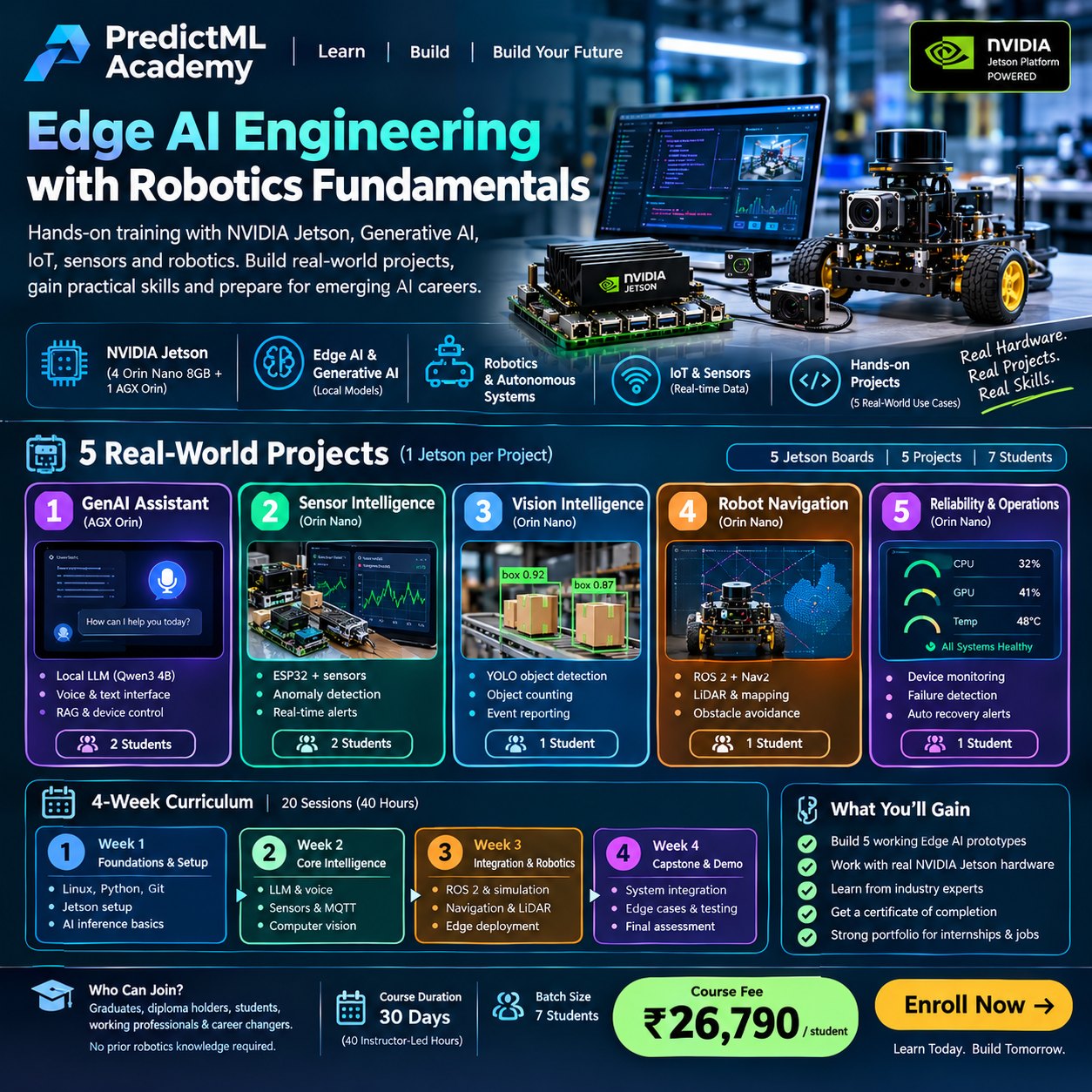
Learn to deploy AI models on NVIDIA Jetson, connect intelligent sensors, run local GenAI, build resilient edge services and explore autonomous robot navigation. Learn through five practical projects using five dedicated Jetson development boards and a shared mobile robot.
No prior robotics experience required. Basic computer skills are expected; beginners should plan for additional Python practice outside class.
Overview
Quick facts
- Duration
- 30-day program / four teaching weeks
- Live instruction
- 40 hours / 20 sessions × 2 hours
- Batch size
- 7 learners
- Lab
- 4 × Jetson Orin Nano 8 GB + 1 × Jetson AGX Orin
- Projects
- 5 real-world Edge AI applications
- Course fee
- ₹26,790 per student
- Audience
- Graduates, diploma holders, students, working professionals and career changers
Why Edge AI?
AI is increasingly being deployed closer to where data is generated: on machines, cameras, sensors, industrial gateways and mobile robots. Edge AI can reduce reliance on continuous cloud connectivity, enable local decision-making and support applications with latency, bandwidth or privacy constraints. Real engineering work also means handling memory limits, intermittent networks, noisy sensors and device failures.
This program goes beyond AI prompts or basic electronics kits. It introduces the complete path from model inference to a functioning device application: Linux and Python, sensor and message interfaces, local models, deployment, performance measurement and safe operation.
What you will learn
- 01Jetson and Linux: device setup, SSH, Python environments, GPU-aware inference and debugging.
- 02AI deployment: pretrained models, quantization concepts, memory, latency, throughput and local APIs.
- 03Local GenAI: small language models, text/voice interfaces, retrieval basics and controlled tool actions.
- 04IoT and sensor intelligence: ESP32, MQTT, time-series processing and anomaly alerts.
- 05Edge vision: camera pipelines, object detection, counting and event reporting as one application of Edge AI.
- 06Robotics fundamentals: ROS 2, LiDAR, odometry, simulation, obstacle avoidance and navigation concepts.
- 07Reliability and edge cases: offline operation, missing sensor data, service recovery, thermal monitoring and safe fallbacks.
- 08Professional engineering practice: Git, GitHub, API documentation, testing, benchmarking and technical demonstrations.
Projects
Five hands-on projects — one Jetson per project
Students work in five small project teams (two pairs and three individual learners). Each project has a dedicated Jetson. All students attend common lessons and must make an individually assessed technical contribution. A shared robot is used for supervised robotics demonstrations.
Project 1
Offline GenAI Assistant
Jetson AGX Orin
Deploy a compact local language model with a text interface and optional voice input/output. Build an API that answers device-status questions and invokes only explicitly approved actions.
Skills: local LLM inference, quantized models, APIs, retrieval concepts, command validation and safe tool use.
Deliverable: working offline-capable assistant with one approved device-status integration.
Project 2
Industrial Sensor Intelligence
Jetson Orin Nano 8 GB + ESP32 + compatible sensors
Read environmental or motion sensor data, transmit it over MQTT, detect unusual patterns and generate alerts. Test noisy, missing and abnormal readings.
Skills: IoT communication, time-series features, anomaly detection, data validation and event-driven software.
Deliverable: live telemetry and anomaly-alert dashboard.
Project 3
Edge Vision & Event Intelligence
Jetson Orin Nano 8 GB + camera
Run a lightweight object-detection model locally, count detected objects and publish meaningful events. Measure inference performance and resource consumption.
Skills: OpenCV, model deployment, optimized inference, camera pipelines and event APIs.
Deliverable: camera-based inference and event reporting application.
Project 4
Autonomous Robot Navigation
Jetson Orin Nano 8 GB + shared mobile robot, ESP32, motors and LiDAR
Explore ROS 2, robot sensors, differential-drive control, mapping and obstacle avoidance. Test waypoint navigation in simulation and demonstrate supervised low-speed physical movement where hardware supports it.
Skills: ROS 2, LiDAR, simulation, odometry concepts, Nav2 fundamentals and safety controls.
Deliverable: simulated navigation demo plus a supervised physical robot demo. Physical SLAM/waypoint navigation is subject to encoder and motor-controller readiness.
Project 5
Edge Reliability & AI Operations
Jetson Orin Nano 8 GB
Monitor the health of Jetson applications and devices, including CPU/GPU activity, memory, temperatures, connectivity and service availability. Detect faults and record recovery.
Skills: Linux telemetry, service monitoring, anomaly rules, health dashboards and resilience testing.
Deliverable: multi-device health dashboard with failure alerts.
Curriculum
Course curriculum — 30 days / 40 instructor-led hours
Delivery: 20 instructor-led sessions, 2 hours each, over four teaching weeks. Additional independent project practice is recommended.
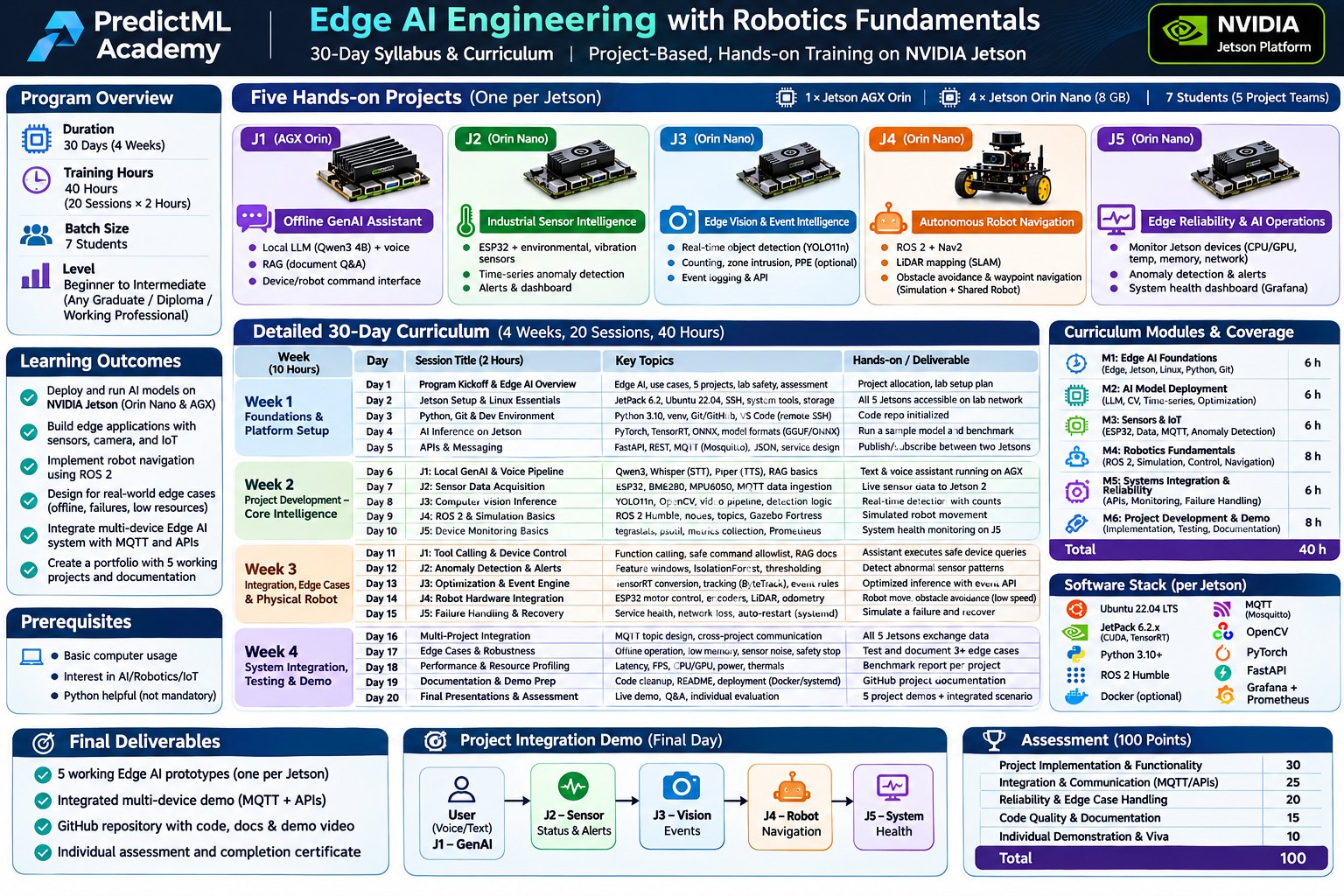
| Session | Topic | Practical outcome |
|---|---|---|
| Day 1 | Edge AI architecture, use cases, lab safety, projects | Understand architecture and choose a project |
| Day 2 | Jetson hardware, Ubuntu Linux, SSH | Connect to and operate a Jetson |
| Day 3 | Python fundamentals, environments, Git | Run and version-control Python code |
| Day 4 | AI inference, model formats, quantization and benchmarks | Execute and benchmark a pretrained model |
| Day 5 | REST APIs, MQTT and JSON | Exchange messages between devices |
| Session | Topic | Practical outcome |
|---|---|---|
| Day 6 | Local GenAI, compact LLMs and voice interfaces | Run a local assistant |
| Day 7 | ESP32, sensors and MQTT telemetry | Stream sensor readings |
| Day 8 | Edge vision and event processing | Detect and count objects |
| Day 9 | ROS 2 nodes, topics and robot simulation | Move a simulated robot |
| Day 10 | Jetson metrics and monitoring | Build a health-monitoring view |
| Session | Topic | Practical outcome |
|---|---|---|
| Day 11 | Safe local AI tools and device commands | Execute an approved device query |
| Day 12 | Time-series features and anomaly detection | Detect abnormal sensor patterns |
| Day 13 | Model optimization, tracking and event APIs | Measure and improve an inference pipeline |
| Day 14 | LiDAR, motor control, odometry and obstacle avoidance | Demonstrate safe robot behavior |
| Day 15 | Service health, lost connections and recovery | Detect and document failures |
| Session | Topic | Practical outcome |
|---|---|---|
| Day 16 | Multi-device integration with MQTT and APIs | Connect the five project services |
| Day 17 | Offline behavior, sensor faults and safe fallback | Test at least three edge cases |
| Day 18 | Latency, memory, CPU/GPU and reliability benchmarks | Prepare performance results |
| Day 19 | Code review, README, GitHub and demo preparation | Publish documented project work |
| Day 20 | Final demonstrations and individual assessment | Present and defend a working prototype |
What you take away
By the end of the program, learners are expected to have:
- Hands-on experience deploying at least one AI workload on NVIDIA Jetson hardware.
- Practical familiarity with Python, Linux, APIs and device communication.
- Exposure to five Edge AI application domains through shared instruction and peer demonstrations.
- A substantial contribution to one assigned capstone project.
- A GitHub repository or documented project contribution, architecture explanation, test results and demo evidence.
- Experience evaluating failures, resource constraints and offline behavior.
- An individual skills assessment and a PredictML Academy certificate of completion, subject to meeting assessment requirements.
Important distinction: Students contribute deeply to one assigned project and learn from demonstrations of the other four; the course does not claim each student independently builds all five projects.
Skills & Careers
Career relevance and job prospects
Edge AI combines transferable software engineering skills with exposure to intelligent devices and autonomous systems. Depending on previous education, technical proficiency and additional practice, this foundation can support applications for internships, trainee roles and junior-level opportunities such as:
| Career direction | Relevant skills from the program |
|---|---|
| Edge AI / AI Deployment Intern | Local inference, model integration, performance benchmarking |
| Python / AI Application Trainee | Python, REST APIs, testing, Git |
| IoT Software / Edge Systems Trainee | ESP32, sensors, MQTT, telemetry and alerts |
| Robotics Software Intern | ROS 2 basics, simulation, LiDAR and navigation concepts |
| Computer Vision / AI Integration Intern | Camera inference, event processing and deployment |
| Industrial AI / Automation Trainee | Anomaly detection, monitoring and device integration |
| Edge Operations / Device Monitoring Trainee | Linux telemetry, reliability, failure detection and recovery |
How the program can strengthen your career profile
- Evidence of practical work
- Show an actual device application rather than only a course completion claim.
- Cross-domain versatility
- Learn skills useful in AI software, IoT, robotics and industrial systems.
- Deployment literacy
- Explain how AI applications behave under limited memory, intermittent connectivity and device failures.
- Interview-ready artifacts
- Use code, diagrams, benchmarks and demos to discuss technical decisions.
- Path to specialization
- Build on the foundation through deeper work in embedded C/C++, ROS 2, SLAM, edge GenAI, MLOps or industrial automation.
Career disclosure: This is a 40-hour introductory foundation, not a guaranteed job-placement program. It does not by itself qualify an absolute beginner for every robotics or embedded engineering position. Outcomes depend on the learner's prior skills, project quality, further practice and employer requirements.
Who Can Join
Who should join?
- Graduates and diploma holders exploring AI engineering pathways.
- Engineering and science students who want hands-on deployment experience.
- Software developers interested in AI outside cloud-only environments.
- IoT, electronics and automation learners looking to add AI capabilities.
- Working professionals and career changers seeking an introduction to practical Edge AI.
Prerequisites
Basic computer literacy and willingness to practice Python. No prior robotics knowledge is required. Students may need a laptop for coding and documentation; please confirm laptop requirements when you enquire.
Fees & FAQs
Course format and fees
| Program | Edge AI Engineering with Robotics Fundamentals |
|---|---|
| Duration | 30-day program / four teaching weeks |
| Instruction | 40 hours; 20 sessions × 2 hours |
| Batch size | 7 learners |
| Training style | Instructor-led, hands-on, project-based |
| Hardware | Five dedicated Jetson boards; one shared robot |
| Project structure | Five projects, assigned in teams |
| Assessment | Individual demonstration, project contribution and evaluation |
| Certificate | PredictML Academy certificate of completion for qualifying learners |
| Course fee | ₹26,790 per student |
| Location | Hyderabad, India |
| Batch dates / venue | To be announced / confirmed on enquiry |
Assessment and certificate
| Assessment component | Weight |
|---|---|
| AI implementation and functionality | 30% |
| Deployment and integration | 25% |
| Reliability and edge-case handling | 20% |
| Code quality and documentation | 15% |
| Individual demonstration and viva | 10% |
Qualifying learners receive a PredictML Academy Certificate of Completion. It is not an NVIDIA-issued or government-accredited certificate.
Frequently asked questions
Do I need robotics or electronics experience?
No. Robotics fundamentals and the shared hardware are introduced during the course. Basic computer skills and a willingness to practice Python are important.
Will I get to use a real NVIDIA Jetson?
Yes. The lab uses four Jetson Orin Nano 8 GB boards and one Jetson AGX Orin. Each project has a dedicated board; students share access within their assigned teams.
Will I build my own robot?
The batch uses one shared mobile robot for supervised experiments. You will learn the underlying software and navigation concepts; a personal robot kit is not included.
Is this only a computer vision course?
No. It covers local GenAI, sensors and IoT, Edge AI deployment, reliability and robotics fundamentals. Vision is one of five project areas.
How many projects will I complete?
You will contribute directly to one assigned capstone and participate in common instruction and demonstrations spanning all five projects.
Can beginners join?
Yes, provided they are prepared to do additional self-study. The program introduces Python and Linux, but students without programming experience may need more practice.
Does the course guarantee a job?
No. The program develops demonstrable foundation skills and portfolio evidence relevant to certain internships and trainee roles; hiring depends on many additional factors.
Will I receive a certificate?
Qualifying students receive a PredictML Academy certificate of completion after assessment.
What is the fee?
₹26,790 per student. Payment terms and applicable taxes will be confirmed before enrollment.
When and where is the next batch?
Please submit an enquiry for the confirmed batch schedule and training venue.
Build AI for the Real World
Move from AI concepts to applications running on real edge hardware. Learn with NVIDIA Jetson, intelligent sensors, local models and a shared autonomous robot in a small, project-based cohort.
30-day program · 40 hours · 7 learners per batch · ₹26,790 per student
Enquire
Enquire / Apply for the Next Batch
Email the Academy with your name, phone number and current qualification or role, and we will reply with the confirmed batch schedule, training venue and payment terms. Course fee: ₹26,790 per student.
- Academy email
- kumar.s@predictml.ai
- Other questions
- Contact PredictML